


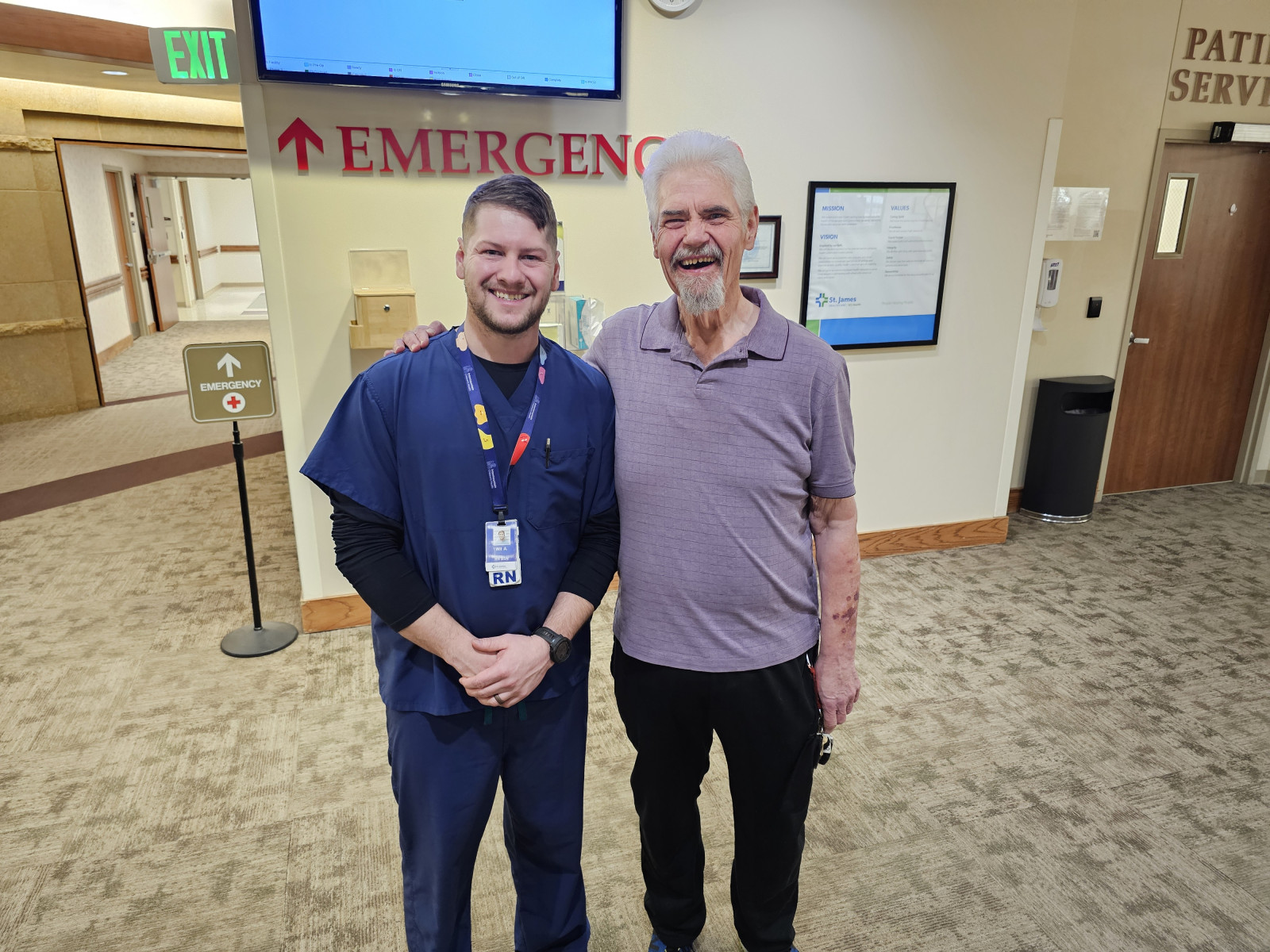
Thanks to CPR Skills, Bystanders – Including Intermountain Health St. James Hospital Nurse – Help Save Life of Montana Man
February is American Heart Month and heart experts at Intermountain Health are helping educate residents about the signs of a heart attack and how to help someone experiencing cardiac arrest.
Unlike what is often depicted on TV, the symptoms of a heart attack aren’t always sudden overwhelming heavy pounding chest pains, and symptoms can vary widely between men and women.
“Men have more identifiable symptoms, like chest pain, jaw pain, or arm pain,” explained Raelene Mulcahy, cardiovascular program coordinator at Intermountain Health St. James Hospital. “Women are a little more subtle with things like stomach or back pain. These different symptoms, along with the sudden onset, results in heart disease being the leading cause of death for both men and women.”
For many people, symptoms of a heart attack can start out as simple discomfort in the arm or back or shortness of breath, which can last for hours and seem like a common illness.
For some, symptoms include discomfort in the center of the chest, which may last more than a few minutes, or it may go away and then return. It may feel like uncomfortable pressure, squeezing, fullness, or pain.
Other symptoms can include pain or discomfort in the arms (one or both), back, neck, jaw, or stomach. Shortness of breath can happen with or without chest discomfort. Possible signs include breaking out in a cold sweat, nausea, rapid or irregular heartbeat, feeling unusually tired, or becoming lightheaded.
For Ralph Boerner, 73, his symptoms last July started out as shortness of breath while he was doing his normal workout at a local gym.
“I just thought because it was a bad air day it must have been impacting me a little more than usual,” said Boerner. “So, I went back to my locker to grab my inhaler and that’s when I passed out.”
Two men, who both happened to work in medicine, rushed over to see what happened, while another gym member called for help. One man is an EMT and the other, Wil Allen, is a nurse in the emergency department at Intermountain Health St. James Hospital in Butte.
“Ralph was slumped up against the locker and we thought he had passed out, but when we checked his pulse, he didn’t have one,” said Allen. “We immediately began CPR and told someone to call 911.”
The men took turns doing CPR for more than 10 minutes until a police officer arrived on scene with an automated external defibrillator (AED) in his car. The portable device can shock a heart back into rhythm, and the team used it twice before Boerner’s heart started up again.
He was rushed to St. James Hospital where doctors opened four blockages in his arteries. Boerner says he’s amazed he didn’t suffer any brain damage considering how long the ordeal lasted.
“I can’t believe I was able to recover the way I did after weeks in the hospital and I was able to go back to the gym shortly afterwards,” said Boerner. “I’m just so thankful for the people who helped keep me alive.”
A heart attack occurs when blood flow that brings oxygen to the heart muscle is severely reduced or cut off completely. This happens because the arteries that supply the heart with blood can slowly narrow from a buildup of fat, cholesterol, and other substances.
Doing CPR helps keep blood flowing through the body and brain which not only helps save someone but can prevent long term damage to vital organs.
Mulcahy says stories like these highlight the importance of knowing CPR to save lives.
She also hopes this will encourage more businesses and public locations to keep an AED on hand.
“People don’t have to be a medical professional to save a life in an emergency,” said Mulcahy. “Knowing how to do CPR and when to use an AED can make all the difference.”
For more information about heart programs at Intermountain Health St. James Hospital, click here.