


With advanced stroke treatment at Intermountain Health St. Vincent Regional Hospital, Billings man looks forward to ‘enjoying life’ again
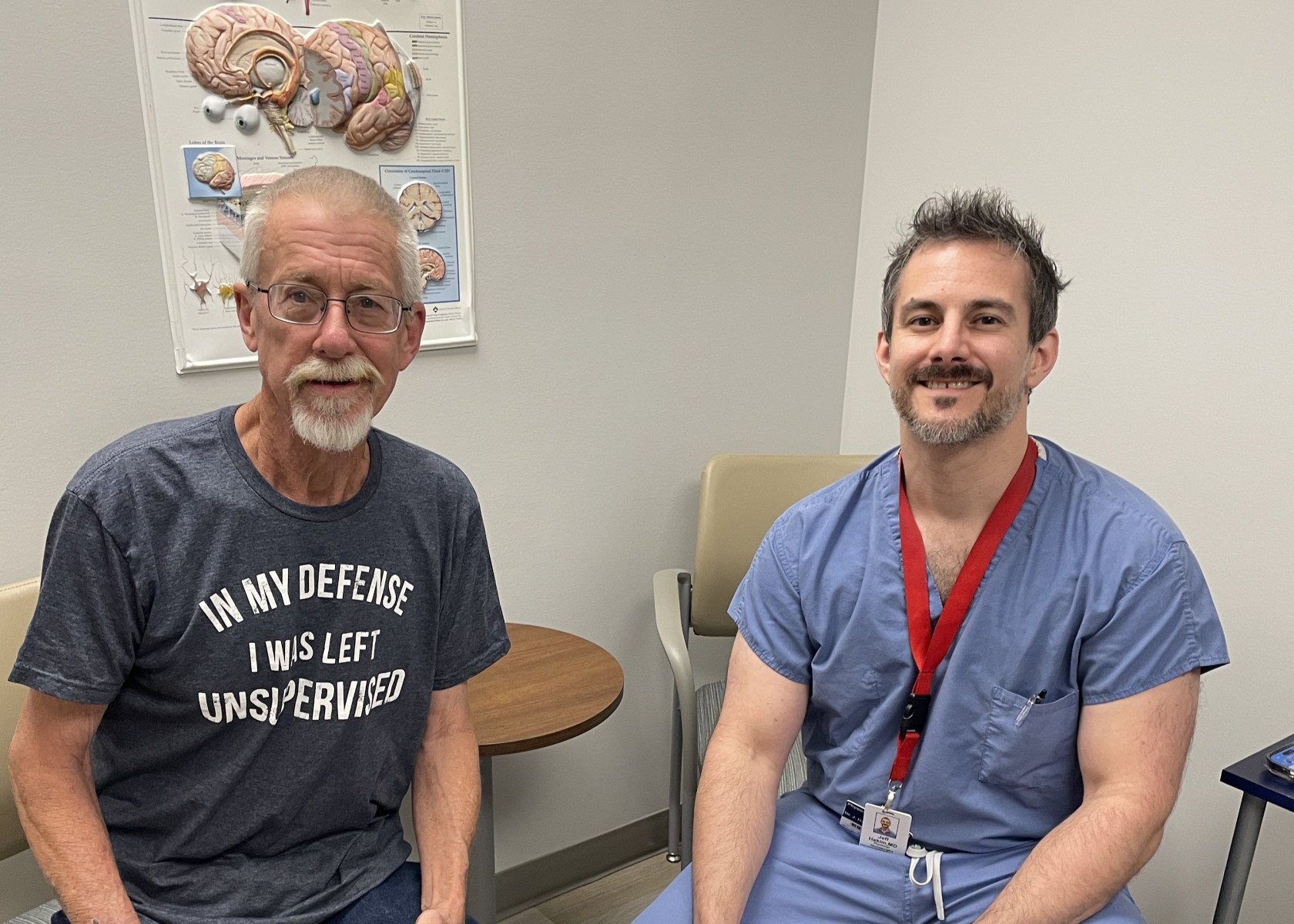
When Dave Siljestrom retired as an electrician from the City of Billings after 30 years, he was ready for a slower pace. Having a stroke at age 71, wasn’t part of the plan. It was early May when his symptoms came on suddenly while he was at home.
“I was sitting up watching TV on the couch and something just came over me,” he said. “I just pitched over and all of a sudden I couldn’t get up and I couldn’t move.”
His wife Debbie came into the room, recognizing the seriousness of his symptoms, and called 911 immediately. The first responders arrived quickly to their home on the west side of Billings, and he was transported to Intermountain Health St. Vincent Regional Hospital for emergency care. The next thing Siljestrom remembers is waking up in the Intensive Care Unit the next morning. While he was unconscious, a rapid response was taking place to save his life and provide him with the best chance of recovery.
“Mr. Siljestrom had a very dangerous type of stroke due to what is called a tandem occlusion, when there is a blockage of both the internal carotid artery in the neck as well as simultaneous blockage of the middle cerebral artery in the brain,” said Dr. Jeff Hakim, MD, neurosurgeon at St. Vincent Regional Hospital.
He was quickly evaluated and prepped for surgery. Using a specialized catheter device and advanced imaging technology, Dr. Hakim and the team had to first traverse the blockage in Silestrom’s neck to remove the clot from the occluded vessel in the brain to restore blood flow to his brain. Next, they used a balloon to expand the narrowed vessel in the neck and place a stent to hold it open.
Having the advanced stroke technology available in Billings at St. Vincent was critical for Siljestrom. These procedures are most effective when performed as quickly as possible because the benefit of restoring blood flow decreases with every passing minute. Once someone begins exhibiting stroke symptoms, the clock is literally ticking. For eligible patients, a thrombectomy, which is the advanced procedure to remove the blockage, may only be effective for up to 24 hours.
That is why stroke experts encourage everyone to understand the signs of a stroke and respond by calling 911 even if the symptoms may be more subtle than those Siljestrom had. Stroke symptoms include sudden trouble with balance or walking, vision changes, weakness or numbness in the face, arm or leg, difficulty speaking, or a severe headache.
Fortunately for Siljestrom, he received that immediate care, and his procedure was a success. He spent the next couple days at St. Vincent recovering and coming to terms with what he had just been through. He then stayed for a few weeks at the Advanced Care Hospital in Billings in physical and occupational therapy before he was able to return home.
He says that his progress has been slow and steady as he continues to work with physical therapy to regain his strength and stamina. He has started to get back into his normal routine with the help and under the caring and watchful eye of Debbie.
“When I am pushing it too much, she will tell me to go lay down and rest,” he said. “She has been a real support for me.”
In his first follow up appointment with Dr. Hakim, Dave realized how close he came to a serious outcome. Dr. Hakim remarked about the progress he had made.
“When we had our first visit with him, he had me walk, turn around and sit down, and he said, ‘you are not the same person I saw in the operating room,” Siljestrom recalled.
“Thankfully, we were able to intervene quickly, and Mr. Siljestrom has had a remarkable recovery with return to independent function,” said Dr. Hakim.
As Siljestrom continues to make progress, he is looking forward to driving again and regaining the strength and dexterity in his fingers to continue his favorite hobby of model building. His advice to others recovering from a stroke: Be a patient patient. “The only thing I would say is just don’t rush it.”